Welcome to my Jaguar Eyes Blog

This is the place to comment on the book. If you liked it or didn't, I would appreciate any comments. If you'd like to know more about the characters or the places in the book, this is the place to find out about them

Saturday, July 23, 2011

Los Pinos


"So it was that we found ourselves back in the enormous parkland that night. We were all wearing black, which was Dominica's idea, but the cloudless night seemed to make us more than visible. It was easy to see the large ornate building glowing in the dark. Lit up both by the moon and the enormous amount of in-ground lighting, there was simply no way that we were going to sneak in unnoticed.

"Why is it called Los Pinos?" I whispered to Dominica as we crouched down in the bushy shadows."


Los Pinos is the official residence and office of the President of Mexico. Located in the Bosque de Chapultepec, the large park in central Mexico City, it became the presidential seat in 1934.


In 1934, President Lázaro Cárdenas was offered use of Rancho la Hormiga (English: The Ant Ranch) as his official residence, which he accepted. He changed its name to "Los Pinos" (The Pines) in honor of the ranch where he met his wife. However, as Bakky found out to his cost, ants still rather like to inhabit Los Pinos.

Tuesday, July 12, 2011

British Museum


"Still, two days later, they were standing in the light drizzle of a chilly London evening, outside the magnificent creamy marble pillars of The British Museum. It had already been closed to the public for an hour and she was meant to be meeting her father-in-law here twenty minutes ago. The air was crisp and clean compared to the dusty, barren Jordanian desert. Although dusk had arrived, the lights of the city avoided darkness. Cars, buses and taxis vibrated their way down the high street, a constant background buzz of noise. High-pitched squeals of disc brakes being squeezed accompanied each change in traffic lights."


The British Museum is a museum of human history and culture in London. Its collections, which number more than seven million objects, are amongst the largest and most comprehensive in the world and originate from all continents, illustrating and documenting the story of human culture from its beginnings to the present.


The British Museum houses the world's largest and most comprehensive collection of Egyptian antiquities outside the Egyptian Museum in Cairo. A collection of immense importance for its range and quality, it includes objects of all periods from virtually every site of importance in Egypt and the Sudan. Together they illustrate every aspect of the cultures of the Nile Valley (including Nubia), from the Predynastic Neolithic period (c. 10,000 BC) through to the Coptic (Christian) times (12th century AD), a time-span over 11,000 years.

Sukhumi


"Their city was called Sukhumi, a port town on the Black Sea. But when the boys were only eight years old, their parents moved to Australia. About as far as you can go from Georgia, without starting to come back the other side again. This should have been a massive disruption for the twins. But since they had each other, they took it in their stride and rapidly assimilated into the relaxed, down under lifestyle. Ironically, it was their parents who struggled with the move and were mostly miserable. They both had to work long hours to survive and hence the twins were sent away to boarding school."


Sukhumi is the capital of Abkhazia, a disputed region on the Black Sea coast of Georgia. 


It is located on a wide bay of the eastern coast of the Black Sea and serves as a port, rail junction and a holiday resort. It is known for its beaches, sanatoriums, mineral-water spas and semitropical climate.

Georgia


"The Kapanadze's originally came from Georgia. A small country on the edge of Europe, which used to be part of the Soviet Union. When this huge Russian empire fell apart, Georgia became independent. It is somewhat ironic that the worst tyrant of the Soviet Union, Stalin, who murdered countless millions of people all over both Russia and its many smaller vassals, actually came from Georgia and wasn't Russian at all."


Georgia is a sovereign state in the Caucasus region of Eurasia. Located at the crossroads of Western Asia and Eastern Europe it is bounded to the west by the Black Sea, to the north by Russia, to the southwest by Turkey, to the south by Armenia, and to the southeast by Azerbaijan. Georgia covers a territory of 69,700 km² and its population is almost 4.7 million.


Dengue fever


"The air was hot, sweaty and close. I was dripping in perspiration and I could smell I wasn't the only one. I wished I were taller and able to breathe the surely fresher air above. I was feeling nauseas and faint. I briefly caught Arthur's eye, before heads cut off the view. Hopefully my look was enough for Arthur to know I was in trouble."


Dengue fever also known as breakbone fever, is an infectioustropical disease caused by the dengue virus. Symptoms include fever, headache, muscle and joint pains, and a characteristic skin rash that is similar to measles. In a small proportion of cases the disease develops into the life-threatening dengue hemorrhagic fever, resulting in bleeding, low levels of blood platelets and blood plasma leakage, or into dengue shock syndrome, where dangerously low blood pressure occurs.
Dengue is transmitted by several species of mosquito within the Aedes genus.

The mosquito Aedes aegypti feeding off a human host


Treatment of acute dengue is supportive, using either oral or intravenous rehydration for mild or moderate disease, and intravenous fluids and blood transfusion for more severe cases. The incidence of dengue fever has increased dramatically since the 1960s, with around 50–100 million people infected yearly, as poor Bakky will attest to.

Teotihuacan


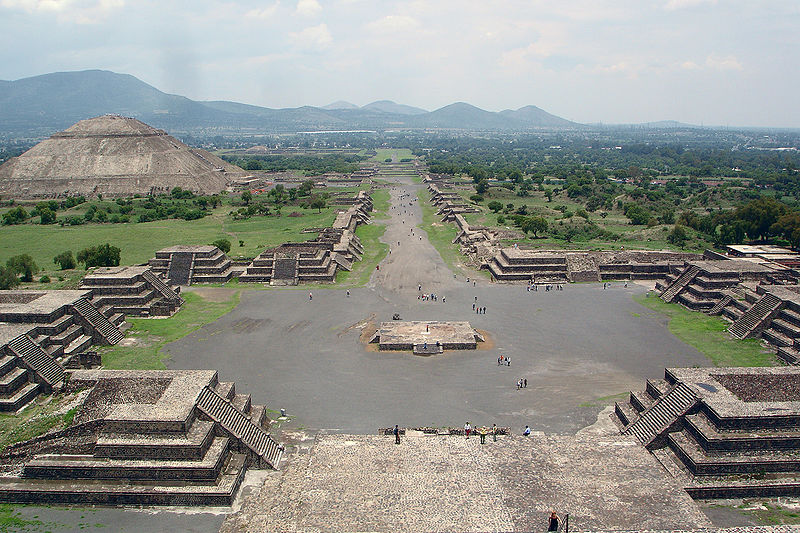
"Already well behind the other three, I finally reached the top. Despite his age, The Professor was surprisingly fit and agile and only Arthur had beaten him to the top. As I arrived, panting and sweating, he welcomed me to the The Pyramid of the Moon and then told me to turn around and look. And what a view it was too. Straight down the Avenue of the Dead. It ran straight, from the base of our pyramid and seemed to disappear in the distance, its direction running into the brown hills. The land around was tanned and dusty, but green trees seemed rather randomly scattered over the area. The smaller pyramids, temples and other buildings made a procession down either side of the avenue, with the huge Temple of the Sun dominating to our left."


Teotihuacan is an enormous archaeological site in the Basin of Mexico, containing some of the largest pyramidal structures built in the pre-Columbian Americas. Apart from the pyramidal structures, Teotihuacan is also known for its large residential complexes, the Avenue of the Dead, and numerous colorful, well-preserved murals. Additionally, Teotihuacan produced a thin orange pottery style that spread through Mesoamerica.

View of the Avenue of the Dead and the Pyramid of the Sun, from the Pyramid of the Moon

The city is thought to have been established around 100 BCE and continued to be built until about 250 CE. It may have lasted until sometime between the 7th and 8th centuries CE. At its zenith, perhaps in the first half of the 1st millennium CE, Teotihuacan was the largest city in the pre-Columbian Americas. At this time it may have had more than 200,000 inhabitants, placing it among the largest cities of the world in this period. Teotihuacan was even home to multi-floor apartment compounds built to accommodate this large population. The civilization and cultural complex associated with the site is also referred to as Teotihuacan or Teotihuacano.

The view from the Pyramid of the Sun

The city and the archaeological site are located in what is now the San Juan Teotihuacán municipality in the State of México, Mexico, approximately 40 kilometres (25 mi) northeast of Mexico City. The site covers a total surface area of 83 km² and was designated a UNESCO World Heritage Site in 1987. It is one of the most visited archaeological sites in Mexico.


Sunday, July 10, 2011

Bosque de Chapultepec


"I love Bosque de Chapultepec," said Dominica, looking around her. "Come, we can wash in the Lago Mayor" and she immediately set off to her right. I looked at Arthur who was still puffing from his climb, shrugged my shoulders and followed her, past bushes and grassy lawns, until we came to a large lake. It must have been quite early in the morning, for the park was mostly empty, but the few people who did see us, took one look at us and managed to rapidly find a path heading in a different direction. We must have looked a right sight, not to mention the smell."


Chapultepec Park, more commonly called the “Bosque de Chapultepec” (Chapultepec Forest) in Mexico City, is the largest city park in Latin America measuring in total just over 686 hectares. Centered on a rock formation called Chapultepec Hill, one of the park’s main functions is to be an ecological space in the vast megalopolis. It is considered the first and most important of Mexico City’s “lungs,” with trees that replenished oxygen to the Valley of Mexico. The park area has been inhabited and held as special since the pre-Hispanic period, when it became a retreat for Aztec rulers.


The park received an estimated 15 million visitors each year, and daily visits have exceeded 250,000. Sunday is the most popular day to visit as the museums are free, and many Mexican families will spend the entire day in one or more sections, walking, seeing the attractions and picnicking or grilling. Despite its local popularity, however, foreign visitors usually only see the small fraction near the museums.


Overlooking the Lago Menor


General scheme of the three sections Chapultepec